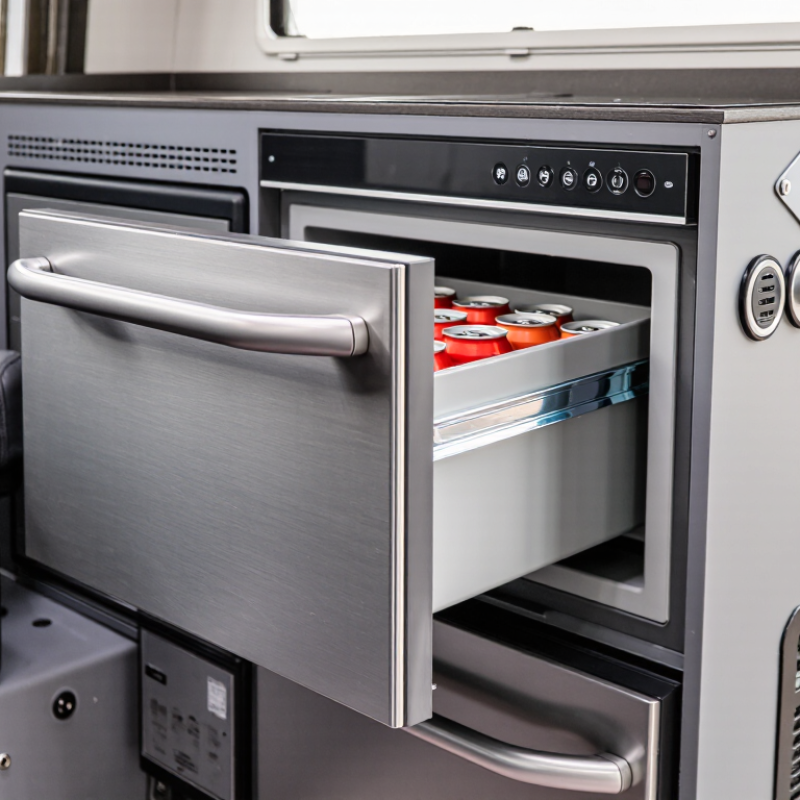
Choosing a Kings Fridge Drawer for global use requires more than comparing storage capacity and price. Buyers must examine drawer dimensions, voltage compatibility, compressor performance, insulation, ventilation, and installation limits. A unit that fits a showroom may fail inside a vibrating camper, marine cabinet, or delivery vehicle.
Refrigeration engineer Alex Morgan says, “Measure the space twice, then question every assumption.” This practical advice matters. Record the cabinet width, depth, height, and front clearance. Check whether the drawer can open fully beside a seat or wall. A small obstruction can make daily access frustrating. It happens.
This guide explains how international buyers can evaluate a Kings Fridge Drawer with greater confidence. It considers different climates, transport conditions, power systems, and service expectations. A 12-volt model may suit an overland vehicle, while another setup may require a stable dual-voltage supply. Hot regions also demand strong ventilation and realistic temperature expectations.
Buyers should review technical specifications from the manufacturer, not rely only on marketplace photographs. Confirm energy consumption, usable capacity, control functions, mounting hardware, warranty coverage, and replacement-part availability. Local support can matter as much as cooling performance. A cheaper purchase may become expensive when a drawer slide, seal, or controller is difficult to replace.
No selection method is perfect. Usage patterns vary. Climate changes. Installation mistakes remain possible. Still, careful measurements and documented specifications reduce avoidable problems. The right Kings Fridge Drawer should match the vehicle, the environment, and the buyer’s long-term maintenance ability.
Define the use case before comparing a fridge drawer. A 12/24V DC model suits boats, trucks, vans, and off-grid cabins. It can connect to a battery system, but startup current still matters. Check the fuse rating, cable length, and wire gauge. Thin cables may cause voltage drops and unreliable cooling. A 100–240V AC model fits homes, offices, and workshops across many regions. Confirm the plug type and operating frequency. Some buyers assume wide voltage support solves everything. It does not.
Climate class deserves equal attention. A drawer used in a humid tropical kitchen needs different protection from one installed in a cool vehicle. Review the declared ambient-temperature range, ventilation clearance, and condensation guidance. Leave space around the compressor area. Heat trapped beneath a counter can increase energy use and shorten service life. In cold regions, performance may also change when ambient temperatures fall below the rated range.
Tips: Match the power source to the real installation, not the planned one. Measure the cabinet opening twice. Check whether the door, drawer slide, and drainage access remain usable after installation. For battery systems, estimate daily energy consumption under realistic temperatures. A quiet test room can hide road vibration, poor airflow, or weak wiring. That is worth reconsidering.
For global buyers, a fridge drawer should match real storage habits, not an impressive catalog number.
Start with usable capacity, not advertised volume. A drawer rated at 100 liters may hold less after baskets, rails, and insulation are considered. Record a typical week of groceries before choosing a size. Measure cartons, bottles, fresh produce, and meal containers separately. Bulky items need clearance above them. Small drawers can become crowded quickly.
Capacity alone is not enough.
Check the dynamic load rating for daily opening and closing. The static rating may describe weight at rest, while the dynamic rating reflects movement on the slides. Heavy glass bottles, full containers, and stacked cans create concentrated pressure. Spread weight across the drawer base. Keep the heaviest items near the center. During travel, uneven surfaces can increase stress on rails and fasteners. Installation experience shows that a drawer loaded near its limit often feels stiff, even when it still operates. That detail is easy to overlook. Leave a practical margin, perhaps 15–20 percent, for unexpected purchases and shifting contents. This is not a universal rule; drawer design and mounting quality still matter. Review technical drawings, test the opening force, and confirm the rating with the supplier before ordering.
For global buyers, a refrigerator drawer should prove its cooling targets under real operating conditions. A 4°C setting is only a starting point. Ask for measured temperatures, not just a control-panel number. Test the drawer after loading it with chilled water bottles, because empty compartments cool differently.
Place a calibrated thermometer near the center of the load. Record temperatures during start-up, door opening, and recovery. A reliable unit should maintain about 4°C during normal refrigeration use. Ambient heat matters. A vehicle parked in a tropical climate can challenge the compressor, ventilation, and insulation. Check performance at the seller’s stated maximum ambient temperature.
Freezing needs stricter verification. The compartment should reach and maintain −18°C, not briefly touch that number. Use a temperature logger when possible. Check the center of a frozen container after the drawer stabilizes for at least 24 hours. Inspect the gasket, drawer alignment, airflow path, and frost buildup. Small gaps can cause large losses.
Do not trust one impressive test. Request recovery data after several openings and a clear power-consumption test. Voltage compatibility also deserves attention across markets. One practical mistake is testing an empty drawer. It can produce excellent readings that fail under daily use. I would also question results taken only near the cold-air outlet. The center of the stored food is more informative. Temperature variation remains easy to overlook.
Choosing a fridge drawer for global travel requires more than checking its advertised capacity. Under IEC 62552 test conditions, compare energy consumption in kWh per 24 hours, not only cooling power. The standard uses controlled ambient temperatures and defined compartment targets, creating a fair laboratory baseline. It does not perfectly represent a hot vehicle, repeated lid opening, or dusty ventilation.
Battery runtime needs a simple calculation. Multiply the drawer’s daily consumption by operating days, then divide the battery’s usable watt-hours by that result. Include inverter losses, often 10–20% in practical installations. A 0.45 kWh/day drawer connected to a 1,000 Wh battery may provide less than two days after conversion losses. Check the small print.
The U.S. Energy Information Administration’s 2020 Residential Energy Consumption Survey attributes about 4% of household electricity use to refrigerators. That figure shows why small efficiency differences matter over long journeys. The IEA’s 2023 Energy Efficiency Market Report also identifies efficient appliances as a continuing demand-reduction opportunity. For international buyers, request IEC-based test results, input voltage details, and performance data at elevated ambient temperatures. A drawer rated at 25°C may consume noticeably more at 35°C. My practical mistake was trusting one laboratory number too much. Real runtime is messier. Compare tested kWh, battery chemistry, cable length, ventilation, and recovery time after opening.
Choosing a fridge drawer for global markets requires more than checking capacity, finish, and cooling performance. Compliance documents should guide the purchase. For European distribution, request valid CE evidence and the related declaration of conformity. UK sales may require UKCA documentation. Products with electronic controls can also need FCC approval for the United States and RCM compliance for Australia and New Zealand.
Ask the supplier for test reports, model numbers, and certification dates. Documents should match the exact drawer, not a similar series. Check voltage, plug type, electromagnetic compatibility, and installation instructions. A practical review also includes warranty length, repair procedures, spare-part availability, and response times. Some suppliers promise worldwide support, but local service may be limited. That gap matters when a compressor stops during a busy season.
Tips: Photograph the compliance label before ordering. Confirm who pays for returns and technician visits. Request written service contacts for each target country. Keep the paperwork with your import records. I would also test one sample before a large shipment; assumptions often fail at scale. A certificate alone does not prove dependable support.
| Evaluation Dimension | Market or Standard | What It Covers | Typical Evidence to Request | Buyer Verification Checklist | Importance |
|---|---|---|---|---|---|
| Product safety and market access | European Union and European Economic Area | CE marking indicates that the manufacturer declares conformity with applicable EU requirements. For refrigeration appliances, relevant requirements may include electrical safety, electromagnetic compatibility, energy labelling, ecodesign, and substance restrictions. | EU Declaration of Conformity, technical documentation summary, test reports from a competent laboratory, product label and user manual. | Confirm that the model number on the declaration, product label, and quotation is identical. Check whether the declaration lists all applicable directives and regulations. | Required where applicable |
| Product safety and market access | Great Britain | UKCA is the United Kingdom conformity marking for applicable products placed on the Great Britain market. Depending on the product category and current transitional rules, CE marking may also be accepted. | UK Declaration of Conformity or applicable CE documentation, UK responsible-person details where required, test reports, and English instructions. | Confirm the current marking route before shipment. Verify that the importer or responsible person information is available when required by UK regulations. | Requirement depends on current rules |
| Electromagnetic compatibility | United States | FCC requirements address radio-frequency emissions and electromagnetic interference. FCC compliance is not a general electrical-safety certification and does not replace applicable safety approvals. | FCC Supplier’s Declaration of Conformity or applicable certification records, test report, product identification, and user-manual statements. | Determine whether the refrigerator drawer contains a digital device, wireless module, display, inverter, or other circuitry covered by FCC rules. Check that the test configuration matches the shipped product. | Required when applicable |
| Electrical, EMC, and safety compliance | Australia and New Zealand | RCM indicates compliance with applicable Australian and New Zealand regulatory requirements, commonly including electrical safety and electromagnetic compatibility. In Australia, some electrical equipment also requires registration in the Electrical Equipment Safety System. | RCM-related supplier documentation, electrical safety and EMC test reports, declaration of conformity, responsible supplier details, and registration evidence where applicable. | Confirm the responsible supplier, applicable voltage and plug configuration, RCM marking, and whether the product falls within an equipment category requiring registration. | Required where applicable |
| Energy performance | Target market-specific | Refrigeration products may be subject to energy-efficiency, ecodesign, energy-labelling, or minimum-performance rules. Requirements differ by jurisdiction and product type. | Energy test report, energy label artwork, product fiche or technical information, annual energy-consumption data, and applicable registration records. | Compare rated energy consumption, climate class, storage volume, and test conditions. Ensure the energy label and product data match the exact drawer configuration. | Check before import |
| Refrigerant and environmental compliance | International and destination-market requirements | Refrigerant type, charge quantity, leakage control, recovery requirements, and restrictions on fluorinated or other regulated gases can affect import, installation, servicing, and disposal. | Refrigerant name, charge quantity, safety data, compressor information, technical service instructions, and environmental compliance statement. | Confirm the refrigerant is permitted in the destination market and that installation and servicing procedures are suitable for the stated refrigerant and charge. | Required for risk control |
| Electrical compatibility | Destination-country power system | Voltage, frequency, plug type, power consumption, inrush current, and protective-earthing requirements must be compatible with the installation location. | Rating plate, wiring diagram, installation manual, plug specification, power-consumption data, and electrical test report. | Match the product rating to the local supply, confirm the correct plug and cord, and verify whether a dedicated circuit or professional installation is required. | Essential before ordering |
| Food-contact and hygiene suitability | Destination-market food-contact rules | Materials and internal surfaces that may contact food should comply with applicable food-contact, hygiene, odour, and cleanability requirements. | Material declarations, food-contact test reports where relevant, cleaning instructions, and internal-surface specifications. | Check shelf and liner materials, drain design, cleaning method, temperature range, and whether the intended food applications are supported. | Depends on use and market |
| Installation and ventilation | Built-in or under-counter installation | Correct clearances, ventilation, cabinet dimensions, levelling, drainage, and heat dissipation are necessary for safe operation and rated performance. | Dimensioned installation drawing, cut-out dimensions, ventilation requirements, mounting instructions, and service-access clearances. | Measure the available opening and confirm front, rear, and side clearances. Verify that the drawer can be removed for maintenance without damaging surrounding cabinetry. | Essential before installation |
| Temperature performance | Product specification and climate class | Climate class identifies the ambient-temperature range used for performance testing. Internal temperature stability, recovery time, and alarm operation are important for stored goods. | Climate-class declaration, temperature test report, set-point range, alarm specifications, and operating manual. | Compare the expected room temperature with the stated climate class. Confirm whether the drawer is intended for chilled storage, frozen storage, or another defined application. | Essential for suitability |
| Warranty coverage | International purchase terms | Warranty conditions define coverage period, parts and labour responsibilities, exclusions, transport arrangements, and the territory in which service is available. | Written warranty certificate, terms and conditions, start-date definition, covered components, exclusions, and claim procedure. | Confirm whether coverage begins at shipment, delivery, commissioning, or sale to the end user. Check coverage for compressor, electronics, seals, drawers, and labour separately. | Obtain in writing |
| Service network and spare parts | Destination country or region | Long-term ownership depends on local technicians, diagnostic support, spare-parts availability, repair turnaround, and clear escalation procedures. | Authorised-service contact list, spare-parts catalogue, parts availability statement, repair SLA, troubleshooting guide, and escalation contacts. | Ask how quickly common parts can be supplied and whether service technicians are trained for the exact model. Confirm support after the warranty period. | Strongly recommended |
| Documentation and language | Destination-market documentation | Instructions, safety warnings, installation information, rating data, and warranty terms must be understandable and supplied in the languages required by the destination market. | User manual, installation manual, safety instructions, label artwork, declaration of conformity, and translated warranty terms. | Check translation quality, units of measurement, electrical ratings, emergency instructions, disposal information, and consistency of model numbers. | Required where applicable |
| Packaging and logistics | International transportation | Refrigeration drawers should be protected against vibration, impact, moisture, incorrect orientation, and prolonged storage conditions during transport. | Packaging specification, handling symbols, upright-storage instructions, pallet dimensions, gross weight, and damage-claim procedure. | Confirm transport orientation, minimum settling time before start-up, inspection requirements, insurance responsibility, and acceptance procedure for concealed damage. | Essential for delivery |
| End-of-life and recycling | Destination-market environmental rules | Electrical appliances and refrigeration equipment may be subject to take-back, recycling, producer-responsibility, and refrigerant-recovery obligations. | Disposal instructions, recycling symbols, producer-responsibility information, refrigerant recovery guidance, and packaging-recycling details. | Identify who is responsible for collection and disposal in the destination market and ensure the manual contains the required end-of-life information. | Market-dependent |